
Not likely to be an impact.
January 14, A Little Direction
Did we call it? Expected gains in the financial sector? Banco Santander (+1%), Société Générale (-.02%%), BNP Paribas (+1.7%) and BOFA (+3.2%). Well, 3 out of 4 isn't too bad. But the sell opportunity for MSFT slipped away. Looking for a little bit more margin before pulling the plug. Look for Banco Bilbao Viscaya Argentaria (NYSE: BBVA) and National Bank of Greece (NYSE: NBG) along with Banco Santander (STD) to reflect easing of tension and improved ability to get credit.
Overall, however, nothing to spark significant gains. Jobless filings for December were up. Oil prices for December also up. Good for the likes of Exxon, BP or Chevron...but not likely to drive the market...and certainly pushing down airline stocks. Retail reports for December show positive, but retail stocks haven't shown the usual post-Holiday bounce. Looking at the DCN portfolio, still waiting on a Nordstrom upgrade, still waiting for JOEZ to get back to a valuation commensurate ith other clothing houses.
A day closer and still no convincing story for the upcoming week. Mixed signals from the US economy for job growth, jobless claims and consumer sentiment. Commodity prices inching up. Manufacturing is up. But not clear who is buying. Intel did great but Best Buy may be following Circuit City down the tubes.
The only undiluted story? The financial sector. PIIGS selling debt, Asia buying debt. US mortgage rates creeping up. Banks still pay next to zero on money they borrow from the fed. Issue: all the bad mortgage paper the banks still hold. But the Fed keeps buying it; maybe to use the land for a new state park in what used to be metro Detroit. The fiscal paradigm underlying banking industry health? Bernanke is continuing the same game that worked with the auto companies. Propped them up until they started functioning. Allowed them to pay off the prop by buying their way out of federal ownership.
What happened? Fed is running profits on the loaned out stimulus money. Domestic car sales are breaking records. Even AIG is starting to look OK. So why not take a ride on the banks? BOFA used to trade over $50; still a long way to go from $15. And an even better story on any bank associated with the Euro.
January 12, Looking for An Uptick
A slight bump in jobless claims and Producer Price index rise of 1.1% made for a lackluster Thursday. Not likely to see mitigating good news on Friday so figure on a downward slide through the end of the week.
PIIGS financial health are ever so slightly on the upswing. A pledge by Japan to buy European debt together with a successful auction of Italy and Spain debt offerings, that's $3.9 billion of 5 year bonds, drove the Euro up 1.6% and the IBEX up 2.7%.
What does this say about the markets at large? Not much. Overall the US economic news is unchanged. Nothing to drive serious movement except in the financial sector. With the reduction in perceived Euro risk, institutions seen as weak/undervalued such as Banco Santander (+16%), Société Générale (+10%), BNP Paribas (+6%) and BOFA (+5.7%) have seen healthy gains throughout the week. Except Germany, low perceived risk/fair valuation and flat markets, put Deutsche Bank (+4.8%) at the low end of the party.
Reduced EEOC uncertainty, a lack of poor economic news could help maintain upward progress in the coming week with a flattening of commodity prices, good post-holiday sales numbers for US consumers providing the stimulus. But absent some indicator of increased activity figure flat, little movement in either direction.
In local news, a change in DCN portfolio is planned with an upcoming sale of MSFT holdings. Purchased at $24, DCN has seen the stock rise to $31 and then fall back to $26. Current fluctuations around the high $28 range together with no obvious harbinger of significant news indicate an opportunity to sell. Despite Kinect hype, Win 7 phone penetration remains on the backburner; Win 7 itself, although a significant improvement over Vista, seems unlikely to blunt increasing competition from the likes of a Google netbook offering, non-Windows tablets, or other consumer-based computing platforms. Still looking at a better than 15% gain on the experience. Commodities seem a natural place to park the cash. CVX was the preferred choice, but at a yearly high seems a little risky (Buy low, sell high....not the other way around).
January 9, Could be a Grim Week
Looks a little grim at the beginning of the week. Gov't reported jobless claims were moderately up on Friday, and new nonfarm jobs were nowhere near expected numbers...103,000 new jobs vs the expected 300,000+. Flooding in Australia is reported to be affecting Asian markets. Other than AORD and NIKKEI, Asian markets are down. The AORD anomaly may be due to anticipated economic stimulus to repair flood damage.
US employment trend looks good with an overall rate down to 9.4%. But anticipate little to downward movement on Monday pending earnings reports from Alcoa, Intel, JPMorgan, Chase and Co. The strong winter storm hitting the South and South East likely to batter airline stocks. More retail sales data expected on Friday. Still looking for that JWN upgrade. Housing seizure litigation caused a 2% drop in Wells Fargo stock. Bank stocks which were enjoying a bump last week as a result of increased rates may see leveling off or follow WFC down.
Good news will have to wait on the retail or earnings data. Expect no change or downside on Monday markets.January 6, Market Indecision Pending Romanian Witch Crisis Resolution
Today, a mixed performance: DJIA was down 0.22%; the DCN portfolio up about 0.1%. But Verizon brought the big news announcing 4G tablets and phones. Based on LTE or Long Term Evolution, the 4 G network provides peak 100Mbps data service...better than most home routers can deliver. And yet, VZ dropped by 2.56%.
Bad weather in the northeast drove same store sales mostly down. One of the few bright spots, Nordstrom, experienced an 8% increase over last year.. Stock was up; wait for upcoming analyst upgrades to see a greater jump. But overall, retail apparel were down.
US Jobless claims were up but the 4 week average is now at a 2 ½ year low. The government employment report for nonfarm payrolls to be announced tomorrow is expected to show a significant increase over November. Unless the PIIGS suffer another crisis of confidence over the weekend, good employment news would translate to another good week of market gains. But Friday is likely to be a nonmover.. China did step up lending to Spain with an announced commitment from Chinese Vice-Premier Li Keqiang to buy $10.3 billion of government debt. That is as much as its Greek and Portuguese debt holdings combined. A companion announcement on Ireland would certainly put the bears at bay.
And the Romanian witch's revolt? Against taxes. This gem, surfaced by AP and carried by NPR reveals the true economic drivers in eastern Europe. Hurling poisonous mandrake into the Danube River on Thursday to express their concern, they are facing a 16 percent income tax and required contributions to health and pension programs. Is this the new form of self-expression? Might we anticipate Tea Party malcontents hurling Bancha or English Breakfast into the Potomac?
January 5, Monotonic Behavior
Missed a day thanks to Verizon FIOS. Internet down. Westel router won't connect. Couple of hours on the phone with no obvious progress. And then, mysteriously, over the course of the next day, suddenly seems to work. Sounds like switching office to me. But Verizon did well. With CES starting up, just a matter of time before the iPhone hits the VZ network. Be interesting to see how Android and iOS 4.2 do when competing on the same infrastructure. And then the Win 7 phones will also come to VZwireless in coming months, according to Microsoft CEO Steve Ballmer. Overall, VZ stock is up 2.9% in the last two days. Probably won't think about selling until the Win7 announcement is imminent.
Oil stocks seemed to hit a cusp. Oil prices staggered back. Dropped to $88 and then made it back up to $90 a barrel before closing. Nationwide gasoline prices are all over the map. West coast has seen $3.50 a gallon so the $4.00 benchmark may not be so far off. Don't believe that anybody has figured out how to put oil BACK into the ground yet....so the trend can only be positive. Chevron (CVX) shrugged off the oil price twitch with a minor 0.17% downside.
Retailers continue to look good. Top performer in the apparel industry is Body Central with 9.4% intraday performance. Two hundred seven stores, trading near its yearly high and still makes better than 9%. Benefiting from the holiday bump. And the JWN portion of the DCN portfolio is holding its own. Nordstrom is up gliding up the hill since mid December. Tomorrow we'll hear directly when sellers report their same-store sales for the month.
But the big news is CES. We will have to see how the market responds to a Motorola...oops, make that Motorola Mobility, is viewed after the XOOM Table announcement. Android 3.0 of course. Have to stack that up against competition from ASUS and Visio. But the Droids have quite a following, might provide a real fast track to drive the XOOM into repeat Motorola customer's hands.
Also in tech., Qualcom confirmed acquisition of Atheros. Merging telecom with networking. Atheros is the No. 2 maker of WiFi chipsets, claiming 21 percent of that market last year, according to data from ABI Research. It was behind Broadcom, which commanded 26 percent of the market, which ABI estimates was worth some $2.6 billion. Atheros' two biggest customers are Hon Hai Precision Industry Co Ltd, which builds Mac computers and iPhones for Apple Inc, and Nintendo Co Ltd, according to its most recent annual report. Others include Dell Inc, Hewlett-Packard Co and Microsoft Corp. Qualcom has been beating the market of late, running about 10% better than DJA since early November. Just about when Cisco shocked analysts with a below-par earnings estimate. Dropped the price from 24 to 19. But they are doing just fine with loads of cash on hand. Can only go up.
January 3, Market Explosion
And the train keeps rolling along. Asian stocks up for the seventh day in a row. What's driving the rush? Pretty much good news everywhere. BofA bought down over $7 billion of failed Freddie Mac and Fannie Mae mortgages for something slightly north of $2.6 billion. Helped fuel a 6% pop. With 787 Dreamliner woes fading out of the headlines, Boeing saw a 2% gain. Fundamentals look good as well: Institute for Supply Management said the manufacturing sector expanded for the 17th straight month in December. The trade group of purchasing managers reported the index of manufacturing business activity rose to 57 last month, a seven-month high. Any reading over 50 indicates growth. Now sitting well above the recession's low of 32.5, hit in December 2008. US holiday shoppers spent at the fastest clip since 2006. Let's see what happens with those retailers.
China could eventually become a low-side driver. Trying to keep inflation in check, by raising interest rates and requiring higher down payments for housing will dampen economic prospects. Housing inflation has been high with prices in 70 cities across China rising 10.3 percent in the year to July, down from 11.4 percent in the 12 months to June and a peak in April of 12.8 percent. Not sustainable. But will the tightening credit reveal a bubble?
Figure on continuing the trend through the week unless Manufacturer's Shipments show a hit. Unlikely with the holiday spending spree. Month to month construction spending was marginally up although still lower than comparable 2009 figures.
| Indicator | Release Date | Period |
| January 3, 2011 | 11/01/10 | |
| Manufacturers' Shipments, Inventories and Orders | January 4, 2011 | 11/01/10 |
| Monthly Wholesale Trade: Sales and Inventories | January 11, 2011 | 11/01/10 |
Bottom line: 7 of 8 Asian markets are up. Few downside indicators. Futures should be in Bull territory. Possible opportunities in Euro-based industries. Oil anyone? Current blip might be a myopic response to the NYC weather. See the American Petroleum Institute Inventory Report tomorrow; the U.S. Energy Information Administration will follow with government Inventory Report at 1530 GMT on Wednesday. Drop in inventory will mean increased economic activity. More fuel for the Bulls.
January 2, a New Year in Business
So the China Procurement Manager's Index dropped a bit. From 53.9 to 55.2 in November. But that may actually be good news. Interest rates are going up as is the reserve ratio requirement for Chinese Banks. Bottom line, capital is more expensive, should put a damper on expansion. But the PMI is still over 50...the typical criterion for declaring expansion.
Probably explains the slow upward drift of US banking stocks. BofA is up about 30% over the last two months....just about the time the Chinese government proclaimed the rate squeeze. And that's the weak sister of the group, WFC and Citi just keep going up.
Not much news on retail stocks yet. Holiday season was the best in years. Would expect retailers, especially the luxury retailers to see some movement. Profits don't really look already priced in. JWN has been flat since the first of November. As has Saks. Interesting PE for Saks; looking pretty hot at 90.68(?).
Supply concerns with Chilean copper mines driving copper to an all-time high of 4.4795 on the Comex. And then the earthquake hit early this morning. Are the mines anywhere near the affected areas? Bulk of the mining territory is in the Atacama Desert in the north of the country accounting for over 30% of the world's mine production of recoverable copper. So, is that an issue? Areas affected by the earthquake are in the south of the country. See the map.
Not likely to be an impact.
Oil is drifting up. Looks like 15% for the year, with a quick ramp-up at the end of 2010. DCN pick of the oil stocks? Figure on BP for a possible 30-40% high side but plenty of downside risk if the Gulf recovery operation has another blip...which could result in a buying opportunity. CX (Chevron) looks lower risk. Good financials, comfortably below the 52 week high. Possible 20% upside with no particular reason to drop. Good opportunity for shorting airline stocks.
Maybe. The current DCN portfolio: BAC MSFT VZ SOHU VALE GE EDU YHOO TEF JOEZ JWN. Recently sold LPHI at 23 after buying it a while back at 19. Then watched it drift back down to the high 17's. The WSJ journal article on asset valuation didn't help. Then the stock started drifting back up. Rode it for a while, made money, but betting on death feels ever so lightly queasy. Course, isn't that what we do with medical insurance stocks? Bet that people will die quickly with the least pay-out necessary.
Happy New Year.
December 22, An Open Letter to Ruth Reichl.
Thanksgiving is old history now, but paging through the New Yorker last night I saw an ad for Ruth Reichl's new collection of recipes from Gourmet. Took me back. One of our family Thanksgiving traditions is home-made cranberry sauce. Not a complicated thing, just cranberries, oranges and apples in the Cuisinart. Blip the thing a couple of times. Add sugar to taste and you're done. Usually kind of tart. May actually be healthy if you go lean on the sugar. But back to Ruth. I'm driving home from work the week before turkey day, switch on NPR and there she is getting interviewed by Susan Stamberg on the radio.
Now I am not really a cook. I can find my way around the kitchen. I get the slicing and chopping chores when we have a big meal. Yeah, I use the bent knuckle trick to avoid a trip to the ER. I do know how to season up something so it tastes OK (to me). But tend to break the yolk on what should be sunny-side up eggs. Anything with technique causes me stress and an urge to flee. Anyhow, smack dab in the middle of this interview about Thanksgiving family recipes I hear "cranberries". OK, maybe it's time to listen up. So this is a recipe that Susan's mother found. Dates back to a 1959 New York Times clipping of a Craig Claiborne recipe. This is not just any old Cranberry relish recipe. This thing has pedigree. Ingredients even had most of my favorite foods!
Ingredients
* 2 cups whole raw cranberries, washed
* 1 small onion
* 3/4 cup sour cream
* 1/2 cup sugar
* 2 tablespoons horseradish from a jar ("red is a bit milder than white")
The real draw was Ruth going on about how it would look. "Having had this on my Thanksgiving table many times, it is really shocking. It's a color that doesn't look like it belongs on your Thanksgiving table.". And then Susan pipes in with "OK, Pepto Bismol pink."
Wow, what a great thing to pull the family together and make the holiday memorable. A large bowl of Pepto Bismol right next to the turkey. Wouldn't that be just fine. So the day of, I look up the recipe and get to work. Made two batches of cranberry sauce: the original recipe - just to be safe - and the contribution from Susan's mom. Chopped the onion. Got the rest of the ingredients. Threw it all in the Cuisinart and started blipping. Sure enough, all started to turn kinda light pink. And then the consistency seemed about right so I carefully poured it into our leaded crystal heirloom bowl. Really set off the pink. And then I tasted it. Kinda strange. Now I do know that some preparations work better after setting up in the refrigerator. Let's face it, even ice cream would be a little overpowering as a soup at room temperature. So lets give this stuff a chance.
A couple of hours go by. And then Ann shows up. Old family friend. Not one to mince words. And she is a cook. Knows the tricks, understands the science. OK lets haul out the cranberry stuff. "Try this". Ann grabs a spoon, tries a little dab. And looks confused. So I try a little more now that it is cold."Interesting". Nicest thing anybody said about it. Ann wouldn't actually commit to not liking it. But, come the Meal, it just sat there. A lovely crystal bowl of pink glop. Kids wouldn't touch it. I did put a spoonful on my plate. I think somebody else did too; there were at least a couple of furrows in the slick pink surface. But it just sat there. And nobody wanted to take some home. Even the brussel sprouts (halved, braised, lots of butter) did well. But not CranPepto.
So why is this an open letter to Ruth? Ruth, you shoulda known! Let's face it, Susan Stamberg is an NPR interviewer. What does she know about cooking? But Ruth. A legend. A name anybody would recognize. Wouldn't be surprised to see Ruth on an Iron Chef panel. But after CranPepto, who knows. I am disappointed. You see the names, the professional foodies, you think they really know stuff. But hey, if even CranPepto can make it onto the talk show circuit maybe its all a sham. Did I miss something? Was it April Fools in November?
September 3, From Long Beach
Are language and engineering both creatures of grammar? Rules is rules, whether man-made or rooted in physical reality. Subject and predicate are bound by rules just as strong as those relating force and friction. Not something most people would willingly accept. Let's face it, the beauty in writing, the fanciful flights of imagination..are those really distinct from the making of machines or the construction of complex mechanisms? Another world? Culture vs. construct?
But maybe it's all the same thing. I often despair at my inability to remember the signposts of culture. Who did what or who wrote, said, or depicted what. And yet the what that they did, the products and ideas. Those are easy. And how things work, that's just as easy. But who did it? Whether it is Boyle's Law or l'Hopital's Rule? Who bloody knows. But how Boyle's Law works or whether l'Hopital's Rule predicts the unpredictable, no problem. Although l'Hopital's rule was kind of fun. Look at this complicated equation of limits. Just keep taking the derivative and eventually you get a solution. Just works. Sure, there's a mathematical derivation, a proof replete with equations and carefully constructed logic. But the geometric interpretation is cute. And easy. And you can just think about it.
Maybe that's the answer. An equation can be thought of as an application of mathematical theorems or as an expression of what happens in the real world.
A + B = B + A
Is that an illustration of the commutative law of addition? Or is it a representation of marriage. Whether George married Sally or Sally married George, you still have a couple. A + B can have children just as well as B + A. So now we have linked the story of George and Sally and the commutative law of addition. Odd. And yet there doesn't seem to be any analysis of the mathematical interpretation of novels. Or even plots. Wow, try Googling that. "Mathematical Interpretation of Novels". A big fat NADA. Not in Google, nor Yahoo. Should get a gold star each time I come up with a logical, grammatical, meaningful English phrase that nets the big fat zero on search. Winning the test of originality. You saw it here. Psychohistory anyone?
!July 3, Letters From Tiburon
From watching fish manage to miss each other at the California Academy of Sciences to building a hearing assistive device for my father-in-law, what a day it's been! Was watching the aquarium down in the basement of the Academy. Hundreds of fish swimming around in a clear-walled tank. Big fish, little fish, red fish and of course green fish. No obvious protocol exchange that I could see; no central controller, just hordes of relatively simple submersible neural units doing their thing in the tank. And they never bumped into each other! Of course that wasn't the first thing that came to mind. The first thing was a fantastical musing about what might happen if I dropped a radio control fish into the tank. Little RC thing with a LIPO battery so it would last a while. And then you could sit in the viewing gallery and run the RC fish all around the tank, scattering the real fish all over the place and having a grand old time. And I checked, you can buy an RC fish. Looks kind of like a Garibaldi. Not Guiseppe, Italian hero and revolutionary exiled to Staten Island, New York who fought for the reunification of Italy until his death on the island of Caprera June 2, 1882. He looked nothing like a fish. His likeness is graven on statues all over the world including a lovely statue in Washington Square Park in New York City. Turns out that Garibaldi fish are called Garibaldi fish because they are the same color as Guiseppe's favorite shirts!
But I digress. The most amazing thing was watching the fish. They never run into each other! How do they do that? Some of them even swim around in formation. Couldn't we get a little of that smarts into an autopilot or something and save all kind of money on air traffic control systems? Let's face it, fish are not usually the sharpest tack in town. Yet they put LA traffic to shame....with a much harder problem. No lanes in the road and they have to worry about moves in all three dimensions. Just something to think about.
And then came the afternoon and a little experiment in audiology. Turns out that as people age, their hearing starts to go. Hearing starts to go, you miss stuff. You really do need to hear with BOTH ears to make the most of whatever you are listening to. But telephones don't work like that. They only play out of one little hole. Bummer. And the sin is compounded when you try to buy a set of headphones and microphone to plug into the phone. Turns out that a lot of phones do have a little jack to let you plug in a headset. But the jack is the skinny 2.5 mm kind. And the headsets built to be used as phones -with the skinny 2.5mm plug- typically have only one earphone; still stuck with the one hole problem. The headsets that do have stereo headphones and a microphone are built for gamers. Gamer headsets are intended to plugged into PC sound cards. The gamer headsets come with separate 3.5 mm plugs: one for the headphones and one for the microphone. So whaddya do? Let me tell you, trying to get advice from the friendly folks at Best Buy or Radio Shack will not get you very far. Best Buy at the telephone counter,"do you have any stereo headsets?". Blank stare followed by "does that have a microphone?". That's why we have different words in the language; headphones are headphones; headsets are headphones with a microphone. So we try over at the gamer side of the store. Yep, they got 'em. But only with the pesky 3.5 mm sound card plugs. Figure we'll go over to Radio Shack and find an adapter. So, buy the gamer headset. Back into the car and drive to Radio Shack. Find adapters. Meanwhile asking, just in case, whether the store actually carries what I am looking for, the two headphone headset. "Oh no, we don't carry those. Had some but the people plugged them into amplified phones and sued us 'cause it was too loud." Then the guy notices that I am buying the adapters. "Don't even try. Phones and headsets use a different kind of microphone. And it's all wired differently". Yeah right, go back 40 years and telephones had funky little carbon microphones....but that's before the Radio Shack guy was even born!
Take it all home. Break out the soldering iron, tie it all together, plug it in and -a miracle- it works! A stereo headset for the telephone. And the father-in-law can use the phone again. This can't be the first time a hard of hearing person wanted binaural sound out of a telephone. Would somebody out there with a small manufacturing capability PLEASE come up with either a stereo telephone-2.5mm plug-compatible headset or a gamer headset to telephone adapter so that hard of hearing people who aren't handy with a soldering iron can still manage on the phone? And let's keep the price down. Parts cost should be under $5 so could easily be sold for $10. Course if its called a "hearing assistive device"; even QVC will demand their $29.95 and shipping is extra.
March 5, On Awareness
Driving the kids to school yesterday. Approached an intersection just a little too fast, but stopped in time. Pedestrian walking across the street. Just started off from the sidewalk and walked across the intersection. Didn't look around. Didn't look from side to side. Just straight ahead, oblivious. If I couldn't have stopped in time, he'd be a goner. So was this guy missing some essential piece of defensive mechanism? Don't the rest of us look up when we find ourselves seemingly headed for contention with a 1.5 ton car? Had he just experienced some soul-wrenching turmoil that made him wish for release, secretly hoping that a subliminally observed vehicle might put an end to his agony. Or was he just unaware?
Awareness is not your straightforward attribute. For some folks awareness might be walking outside and observing the plants and flowers and knowing the names of each of those organisms, their likes and dislikes, latin names, and growing cycles. For other folks awareness might be the pain shooting down their sciatic nerve as they stir their spine into motion after a night of fitful sleep. Still other folks might experience awareness as a visualization of pistons moving up and down in their steel collars propelling an automobile down the street.
Reminds me of a book, Breakfast with Buddha by Roland Merullo. I am not sure that the Buddha in the book is a real Buddha. For one thing he is Russian rather than Indian. But I did a little research on the nature of buddha-hood (which seems to be a real word). Being Russian is OK. Russians can be Buddhas. Per the wiki, this character seems to have the characteristics of a Sammasambuddha. A Sammasambuddha is someone who has somehow attained buddha-hood, then decided to teach others the truth he or she has discovered. We are talking spiritual kind of guy. Volya Rinpoche, the guy, has a following drawn by his convincing spiel. The gist of what he says is that we should be open to life. Open seems to mean an ability to experience life unhindered by expectation or a need to judge. Be simply open, ready to accept what is, what happens. Seems related to "not-self" a term translated from anattā (Pāli) or anātman (Sanskrit) in the literature on Buddhism. Actually like a Will Ferrell movie of all things, "Stranger Than Fiction". Will Ferrell's affect as IRS Agent Harold Crick is an amazing depiction of not-self. He is totally accepting. No judgement. No pushback until the outcome, his death at the pen of Karen Eiffel played by Emma Thompson, might seem fatal.
So are awareness and this Buddhist not-self idea somehow related? If you have too much going on inside; if you are concentrating on your life, your private agony, reliving a pleasure, do you lose the ability to experience what is outside? Like retracing the same path in your car year after year to the point that the drive becomes an opportunity for meditation, but you lose the ability to experience the warmth of the sun, the look of distant mountains, the smell of rain.
Sort of interesting that Transcendental Meditation came out of the same school as not-self. With TM, you recite a mantra over and over and over again. Eyes closed. And your mind shuts down. Said to transcend thought through a process that Maharishi Mahesh Yogi in The Science of Being and Art of Living described as a mental procedure that allows the mind to quiet itself. But that seems the opposite of awareness and not-self. As if awareness were the opposite of meditation. Awareness is the letting in of the outside. Meditation is all-self, a closing off. Too much awareness can drive you a little crazy. Too little and you don't make it through the crosswalk.
February 14, Reach Out To Me, Mr. President!
Driving in to work the other day I heard the news on KNX, Judd Gregg backed out of the Secretary of Commerce job. First Richardson, now Gregg. Richardson, I understand, "Pay for Play" allegations can be a little embarrassing. The Judd Gregg thing is puzzling. Sounds like Judd wanted the job...and then got nervous. But hey, politicians are fair weather friends. Vote public opinion and you'll have a House to live in till the rest of your days; go against the grain, vote your heart and you better start looking homeward.. In this case, it may have been vote against your party or deny your party that extra vote in the Senate, but who can tell. At least he didn't leave you in the lurch after a couple of months on the job.
So, Mr. President, I want to help out. After minimal consultation with family and friends, I am throwing my hat into the ring. Reach out to me, Mr. President! I can do the Commerce job. After getting twice burned, I don't expect you to leap at the prospect without a little background on my credentials. I looked for an application at usajobs.gov, but couldn't find the listing for Secretary of Commerce, so I hope you'll understand my approach. Call it an open resume.
I should begin by stating that I am a registered Republican. I joined the Grand Old Party right out of graduate school on the advice of my old friend Hobart. Hobart pointed out that nearly everyone he knew had started out a Democrat, but once they achieved some career goals and bought a first house they moved over to the GOP. I didn't have a house and at the time was earning significantly below the poverty line but I took Hobart's words to heart. I wanted to have a house and I certainly wanted to increase my income so I figured that joining the GOP would sort of bootstrap the rest of it. I do now have a house and my earnings place me somewhat over the poverty line (family of four) so I guess it worked. Thank you, Hobart. But I must confess, Mr. President, even though I have been a registered Republican lo these many years, even though I have voted in nearly all the Republican primaries (except the last two); I must confess that in no general election have I brought myself to actually vote Republican. Whether this be a failing on the part of myself and my conscience or, perhaps, the GOP itself, I cannot say. However, I do feel it incumbent upon me to come clean at this juncture, my possible first foray into Washington politics. Despite my lack of a clear ideological compass, should you feel the need to reach out across party lines, Mr. President, I stand ready.
But enough of my political affiliations, what are my qualifications to assume the office of Secretary of Commerce? What is it in my background that allows me to hope, even imagine that I could make a contribution at such an exalted level? Long time readers will note that I have some acquaintance with software. This acquaintance springs from working within a large software development organization supporting the DOD. Thus situated, I have some experience with government procurement practices, both in nascent form when a program is still but an idea as well as in full bore operational form when the full weight and measure of the government regulatory practices can be brought to bear. I must admit that knowledge of these traditions has not fostered in me an inordinate appreciation of their value. The correspondence between metrics and accomplishments remains, for me, an unproven relationship. The ability of small groups to create vast achievements contrasted with the ability of large groups to spend correspondingly large amounts of money without creating similarly large capabilities has fostered in me perhaps a cynical view of the process as it is exercised by large government programs. And yet I exist quite happily within that world. Mr. President, I stand ready.
I do have strong opinions, backed by quantitative analysis, of the directions our government - dare I say it - my cabinet department might take as elixir for our current economic impairment. Past readers will note that within this column, I have proposed "making well" the tens of thousands of mortgages falling to foreclosure each month. I have provided projections of the expense of such balm and noted that the cost is well within the scope of funding applied to TARP and the latest government economic fix. These opinions and ideas are not without a certain historical basis in economic theory. John Maynard Keynes in The General Theory of Employment, Interest and Money wrote
"a large proportion of our positive activities depend on spontaneous optimism rather than mathematical expectations, whether moral or hedonistic or economic"
Pretty exciting stuff, but what better way to create a little spontaneous optimism than to fix all those bad mortgages. Tax breaks, that extra $5 to $10 a week, do not create optimism. The most likely scenario is that the money will go to one more fast food outing, leading to heartburn and yet one more percentage point in our country's embrace of obesity. Consider an alternative. Create a symbol of hope, a stars-and-stripes embossed government-standard envelope containing mortgage relief, delivered to a foreclosee's door. The contents of the envelope document a promise to make the unmanageable house loan, thanks to a change in the nation's economic policy, now manageable. Talk about raising the spirits. And what better way to celebrate than putting some newly-spendable cash into the local economy. Would it be expensive to make all those defaulting loans well? Of course it would, but the analysis (see the archives at datacorner for the numbers) suggests this fix is way cheaper than proposals currently on the table. Imagine the impact on national morale, immediately lifting what Keyes called the "depressed animal spirits" now dragging out the recession. Mr. President, I stand ready.
So Mr. President. Reach out to me, a lapsing Republican, an engineer, a software developer, husband and father of two - I hew to academia's tradition of putting the most important attributes last. All I can offer is pragmatism, facility with numbers, and an adequate dose of common sense (although writing this blog may give lie to the last observation). Is this the ground from which the next Secretary of Commerce will spring? Much as the carefully tended tomato seeds refuse to spring from the planter in my backyard, I doubt it. But should you make the offer, I pledge to continue your tradition of complete sentences noted by Andy Borowitz in his November 18 column, and I do remain untainted by any appearance, actuality, or even opportunity for "pay for play" or tax dissimulation.
February 7, Aliens Write Software Too
Or do they. Threw this little gem out at dinner the other day. Came from sitting at the laptop and wondering about spaceships. The little green guys that motivated Independence Day and Area 51, do they have guys sitting at laptops too? Being a software person, I figured the answer must be yes. But number one youngest daughter (at the dinner table) had a different take. "What if they don't."  How do you answer that? Might start with, "what is software?". As a working definition, let's say software is anything that lets you take hardware, a concrete thing that you can touch and feel, and then cause it to change its behavior or function. In a very limited sense, a switch might be considered a piece of software since it can cause a lightbulb (thing which you can touch and feel) to change its behavior (lights up and if you feel it and touch it you probably get burned). Course a switch is a pretty simple piece of software, but the lowly switch does cover a bunch of attributes associated with software: configuration, ability to change state, memory are a few. More complicated software would have a bunch of switches and more complicated functions...but you get the idea.
Ok, so do aliens have software? Or not. Let's get on with it. Consider the spaceship (that's the Millenium Falcon being refueled down below). Pretty complicated piece of thing. Lots of moving parts. Can stretch or exceed normal physical limits. Can keep the driver alive in the "vastness of space". Means supplying whatever the driver breathes and eats and handling whatever comes later. Means the ability to go pretty fast, unless aliens live
  really long. Means the ability to counteract gravity...which is not such a problem when you're in space since even low-power ion propulsion can work. But it gets pretty important pretty darned fast when you're falling through the atmosphere. So a spaceship can do an awful lot of things and probably do them pretty well. And? Well, pretty complicated things usually have a lot of parts. For the whole spaceship to work, all those parts gotta work, too. Which introduces the idea of yield.
What's yield? Suppose the spaceship needs 100 thrusters to get off the ground. You can make 100 relatively simple thrusters and hook them up to the spaceship or you can make a single really complicated thruster that does the work of all 100 simple thrusters. But the really complicated thruster will have a whole lot more pieces to it then the 100 simple ones. So the really complicated one takes a whole lot longer to build, and if it does break, you really are hosed. Think single engine airplane and the engine quits. Remember that guy who just landed the airplane in the Hudson? His plane had two engines and they both, simultaneously, choked on a bunch of birds. 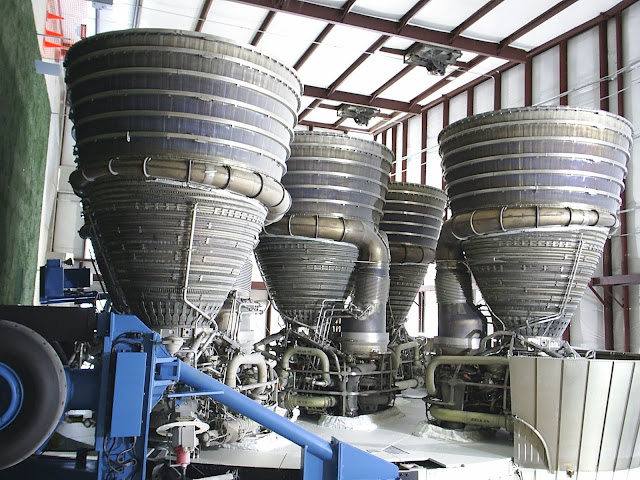 If you'd said, just before takeoff, "Sully, you are about to fly in to a flock of birds. Would you rather be flying a twin engine A320 or a four engine 747. Whaddya think?" Go ahead, take a guess at the answer. So, even the alien, might prefer a 100 thrusters to a really complicated single thruster solution. Imagine we're now at the Thruster Assembly Plant - out there in alien-land. The assembly plant is churning away. Workers hunched over the assembly line. All those thrusters coming down the conveyor belt. And you've got the alien chief tester all the way down at the end of the belt. The chief tester is responsible for making sure that each thruster actually works. Unfortunately, it turns out that they don't all work. Turns out that about 95 out of every 100 are OK; 5 don't quite make spec.
Those 95 out of every 100 work, right out of the factory, but what happens in space? Well, hopefully the aliens did some end of life testing...means running a bunch of thrusters till they poop out and seeing how long that takes. If you're gonna put your best spaceship pilot in this thing and go across the "vastness of space", you probably want some expectation that your pilot will come back....or at least keep communicating until we've all lost interest. So, lets assume that trip across "vastness of space" from alien home-central to earth is a week. The end of life testing reveals that if you put 100 thrusters on the spaceship, you run them all for a week, they still all work. But if you run them for two weeks (don't forget the trip home), a couple of them break. So what to do? OK, if the spaceship needs a 100 thrusters to move around, let's put in a couple of spares and when a working thruster breaks, we can switch in the spare.
A switch. Isn't that how all this got started? Yep, for most conceivable complicated things you want to do, you do need some means of affecting or changing the thing's behavior. At the very least, you need a switch. But it could get even worse. Suppose in doing the end of life testing, the aliens found out that if, rather than run each thruster until it stops working, you give each one a break every once in while. Turns out thrusters really like those breaks. Turns out that thrusters run that way, with breaks, stay alive twice as long! Wow. Back to the spaceship. So, let's say the green guys put in 10 spare thrusters. Rather than letting them sleep until something breaks, the alien chief tester suggests a new strategy. Rotate through all 110 thrusters. Every once in a while, the chief tester guy says, give 10 thrusters a break, keep at least 100 of them running. What happens? End of life testing says they will all last quite a bit longer....and you still get some spares. Those aliens are pretty smart.
So what needs to happen to implement that strategy? You probably need 110 switches to turn each thruster on and off. You probably need to remember which thrusters last ran so you get an idea which ones need to get a break. If a thruster goes south, you probably want to remember about the broken one so you never try to use it again. All that stuff to remember, and it has to be ready to change on moment's notice...like when the spaceship hits a flock of birds. Oh yeah, no birds in space, all right, maybe when the spaceship is landing. Back to our definition of software, "anything that lets you take hardware, a concrete thing that you can touch and feel, and then cause it to change its behavior or function", looks like we can make a pretty good argument that a safe (good against breakage), efficient (good use of spares) spaceship probably has something like software....and that's just to move around. Also has to navigate and keep the pilot alive and all that stuff...but that might be chapter 2.
So maybe there are little green guys sitting at laptops messing with software. Kinda weird. Is the existence of software one of those absolutes? People gotta breathe and eat. To exert a little control over the breathing and eating they build stuff. And when the stuff gets a little more complicated they gotta write software. Might software be an expression of existentialism, our -and the green guys- autonomy over the physical world? The developer of software imposes a his/her/its own view of reality upon the physical attributes the software controls. According to Sartre, "Evil is the product of the ability of humans to make abstract that which is concrete." What is software other than an expression of the ability of humans to make concrete that which is abstract?
February 3, Forget the Bailout, A Better Fix.
What's it gonna take to fix the economy? Well, it sure isn't saving money. Your friendly Commerce Department just released data showing personal savings rate going from 2.9% to 3.6%, second highest rate in a year. What do our exPrez and Mr. Keynes tell us as a way to get out of this mess?  Answer is simple; spend don't save. Spend money and businesses get revenue. They get revenue and all them stuck economic wheels start to turn. But where are we gonna get the money?
A huge bonanza of cash remains lurking out there in the economy. More money than the TARP and the AIG bailout and all the government grease used to slide the Wells Fargo Wachovia and Bank of America Merrill Lynch accommodations into place. So much money. Where is it hiding? Apart from documenting the continuing slide of business and investment credit, your friendly Federal Reserve also provides detailed information on retirement funds. Table 118c downloaded from their website lists total assets for "Private Pension Funds Defined Contribution Plans" as, get this, 3.5 trillion dollars as of the end of 2007. Sure its gone down a bit since the crash of '08. Let's say 40% to be generous. That would still leave something north of $2 trillion in those accounts. Just sitting there.
Can we spend it? Nope. Under age 59 and a half and the government adds a 10% penalty. And of course anything you pull out just goes against income so it bumps your overall tax rate as well. So, is anybody spending it? Not unless you really are broke. And then the money is probably getting used to salvage a mortgage. Not buying goods and influencing businesses.
Is this a good long term approach? Well, by the numbers its kinda dumb. What are you going to do in 20 years when you need the money that was in the 401K? Actually the question -and answer- are not all that simple. Remember that $1.5 trillion of your 401K just evaporated in the final 4 months of 2008. Did we (or you) get any value for that money? Nope. So what if the floodgates opened a bit so we spend some of the un-evaporated residual. And then the economy gets a little bit better. And, amazingly, the value of the remaining holdings gets a little better, too. Sounds like Pollyanna don't it. Something for nothing. But why should this be crazy? We just lost a whole bunch something for nothing in the last third of 2008.
Let's face it. Economics modelling has been revealed as a recipe in search of science. Dear old Alan Greenspan is left with,"those of us who have looked to the self-interest of lending institutions to protect shareholder's equity (myself especially) are in a state of shocked disbelief." Didn't he ever consider self-interest as a motivator? 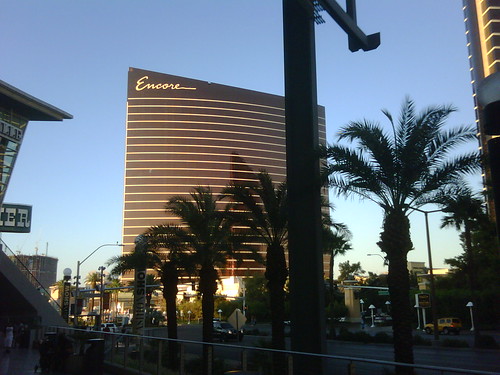 How do you compare shareholder equity with an Aston Martin and a Manhattan penthouse (including garage containing aforementioned Aston)? Wells Fargo was just caught willing to spend the bailout money on a Las Vegas junket. Screw shareholder equity. Till the news broke, anyway. So maybe its time for something new. Just an idea, and Barak doesn't have to print more money to make it happen.